


I don’t remember this happening, but there is a story from my youth that has been told and retold by my family members so often it’s become part of my lore: When I was in preschool, everyone in my class was asked to share their favorite movie. When the teacher called on me, I stood up and proudly shared the film I was at that point watching on a loop after school: The Best Little Whorehouse in Texas.
The film starred Dolly Parton as, well, one of the titular characters and Burt Reynolds as a sheriff fighting to keep his favorite brothel open. It is campy and wonderful and as a five-year-old I didn’t understand what, exactly, the women did in the aforementioned whorehouse, but I knew that I liked the music and adored the woman with the big blonde hair.
If you’ve read this newsletter long enough you know my backstory: My mom was shot in the head when I was six weeks old, in the small town in North Georgia where I was born. My mom survived but suffered a Traumatic Brain Injury, and my grandmother raised me as her own from that point on, moving the three of us to Florida when I was a few years old.
Maybe it’s because she had already raised kids once and was exhausted from life, or maybe it’s because she was very progressive, but my grandmother really had no rules regarding the content I consumed.
I was treated, essentially, like a small adult. Art and nudity and cursing weren’t things to hide; they were part of life and worthy of discussion (I am forever grateful for being raised this way and will say, as an aside: I was a very good girl.)
Following her brain injury and before the introduction of powerful pain medications, my mom would spend her days watching Turner Classic movies and listening to country music in her bedroom.
My mom was my introduction to Dolly Parton. And since my grandmother did not care what I watched, The Best Little Whorehouse in Texas became my favorite movie. And Dolly, the biggest star in my sky.
A prolific (and brilliant) songwriter, Dolly is responsible for some of the best songs ever recorded: “I Will Always Love You,” “Jolene,” “Here You Come Again” (a personal favorite). She was a fantastic actress, having appeared in Steel Magnolias, 9 to 5, Rhinestone, and a litany of smaller, made-for-tv movies and specials.
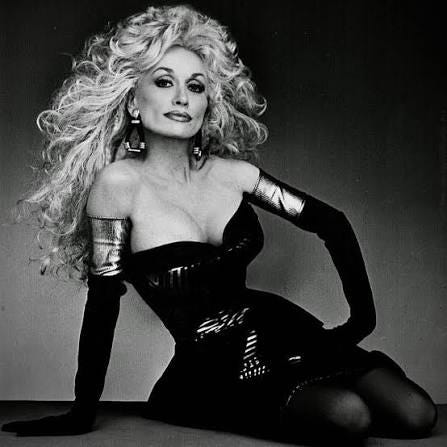
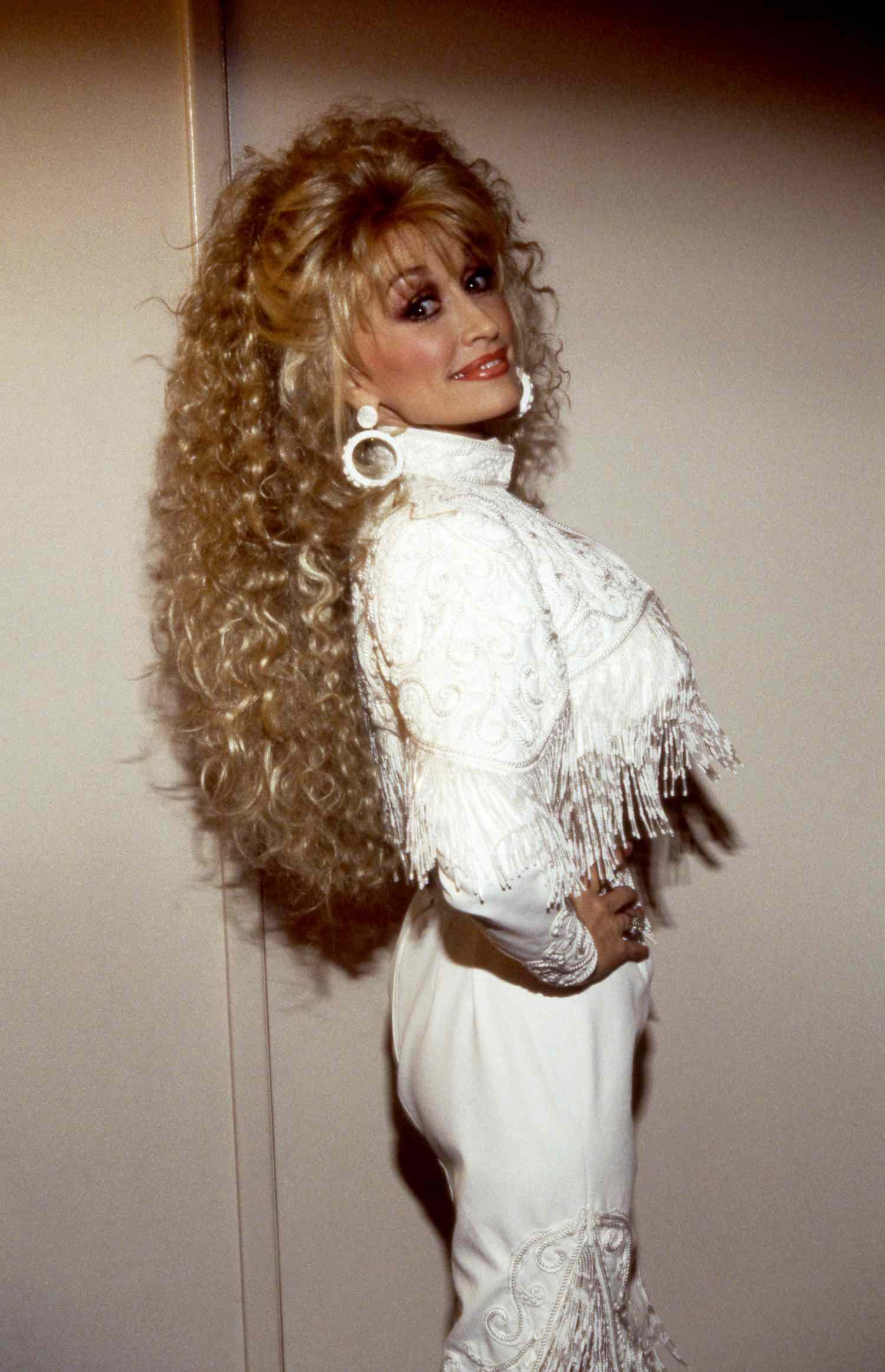
Dolly is also famous, of course, for her intensely specific aesthetic. A little bit too much, she was, with her big hair and nipped-in-waist that seemed too diminutive to support the weight of her eyelashes and nails, let alone boobs.
Born to a dirt poor family in rural Tennessee, Dolly famously came to her point of view early on in life, taking her style cues from what she called the “town trash.” She was, outwardly, a caricature of a woman, fully embracing everything it meant to be “tacky.”
But oh, she was fierce.
One of the best demonstrations of this came during a now-famous interview with Barbara Walters in 1977. Walters asked questions that, in hindsight, are breathtakingly condescending — implying that Dolly was a “hillbilly,” and pointing out that Dolly didn’t have to wear the wigs or the exaggerated clothes. Walters wondered, out loud, whether the spectacle of her looks made Dolly into some sort of a joke.
Throughout the questions, Dolly remained nonplussed, dismantling each with such quickness and confidence that the entire premise — that a woman with big boobs and long nails couldn’t also be smart or artistic — began to collapse.
And when Walters suggested that she didn’t have to look the way she did, Dolly agreed, saying she looked the way she did because it was a “choice.”
“I would never stoop so low as to be fashionable,” she told her.
The hair and the rhinestones and the epic proportions of her body were enough to throw any interviewer off their game, but Dolly was always several steps ahead anyway. She could disarm anyone with a joke (just look at any clip of her on a talk show and you’ll find yourself shocked at the speed with which she delivers a punchline).
For someone who gave so much of herself to the public, Dolly also knew what to keep to herself. Her nearly 60-year marriage to Carl Dean remained largely out of the public eye, and she spoke openly about not having children without ever treating her life as incomplete.
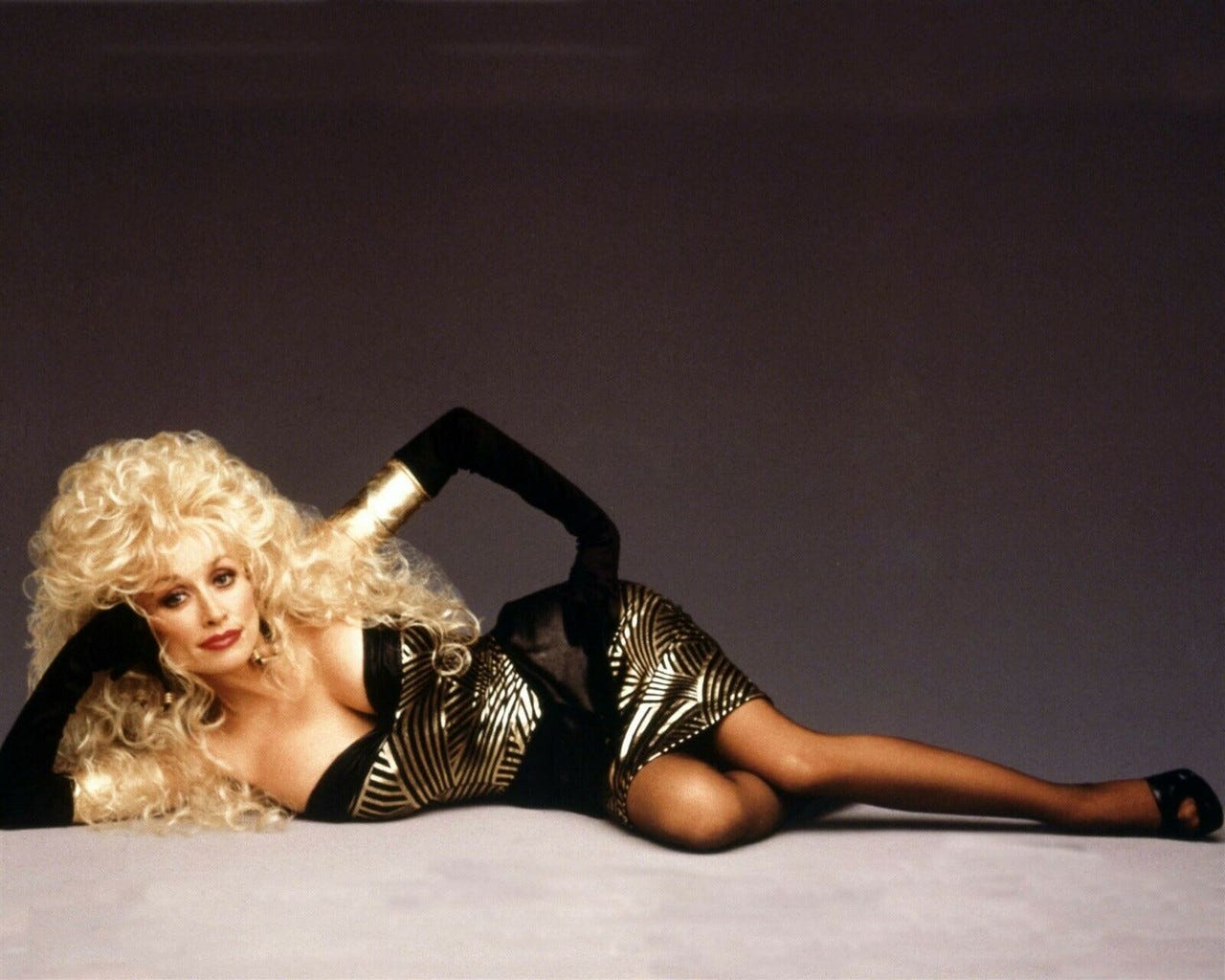
A legend now, for sure. But in the 1970s, ‘80’s, and even beyond, many held Dolly up as an example of bad taste.
I have written before about how what the majority of people consider to be “good taste” is really not “good,” at all, but simply palatable. It’s easy to absorb. Asks nothing of the rest of us.
But that’s not exactly compelling.
Nor is it thoughtful.
“It costs a lot to look this cheap,” Dolly once famously said, and indeed, the time and effort she put into her aesthetic is incredible. A true artist, transforming into a walking, talking, singing work of art. She famously wore wigs and bedazzled clothing (much of it with long sleeves, to hide the many tattoos she had all over her body).
As I wrote in my essay about The Ugly-Chic Theory, I have long sought beauty in the slightly off-putting:
Design that is too perfect — too symmetrical, too balanced, too pristine — feels unlivable. Slightly off kilter or, dare I say, slightly tacky, feels more fresh and interesting (almost like spotting Dolly Parton in a sea of Stepford wives).
Having come from a town just a stone’s throw from Tennessee, where Dolly is from, I grew up around women who sound exactly like her. Women who also have peroxide blonde hair and never miss a nail appointment (you may have noticed, I don’t miss one, either).
But there’s something else about that part of the country that I think many people don’t see: there is an artistry and a weirdness to the American South unlike anything else. So many musicians and folk artists hail from North Georgia and Tennessee and many of them, like Dolly, came from nothing. Still, they built fantastical, larger-than-life worlds — as a choice, without caring what other people thought about their aesthetic point of view (Howard Finster, a Baptist preacher-turned-folk-artist, created an over-the-top home and studio that you can still visit in North Georgia, very near the town I was born in. It is what most would call tacky and it is absolutely wonderful).
There is power to refusing the conventions of “good” taste and embracing tacky. There is power in being too much and never toning it down, even if society wants you to.
It is rare for the loss of a celebrity to unite so many, but Dolly herself was rare.
There is this strange notion in our modern age of social media that authenticity requires crafting the most stripped-down version of oneself. I’ve noticed it in the recent discourse around manicures, in which “successful” women influencers talk about how they no longer get their nails done, because they simply don’t have the time. But is going bare-nailed or bare-faced authenticity or is it artifice? Dolly was likely busier than us all — more successful, certainly. Yet she carved out time for the nails, and the hair, and the makeup, because that was all a part of who she was. That was as much her artistry as the music itself.
Dolly was, and is, proof that femininity and fierceness are not opposing forces. That you can be clever and talented, and a push-up bra won’t take away from that.
Her big hair and her thick accent feel familiar to me, like the women I remember holding me when I was a little girl and would visit Georgia. Incredibly independent but Southern and in some ways traditionally feminine to the core. My grandmother, for instance, implored me never to tie my worth to a man, and only dated one man during my lifetime (she broke up with him when he proposed). But you better believe she was first in line at the Lancôme counter when they debuted a new gift with purchase and, like Dolly, never treated femininity as something she had to overcome in order to be taken seriously.
I love a woman who doesn’t tone herself down in order to justify her intelligence, a woman who knows that looking like a man’s fantasy doesn’t require behaving like one.
It might seem strange to wax poetic about a musician in a newsletter devoted to design, but Dolly’s aesthetic ethos has always been inspirational to me. I love the fancy and luxe, but I am obsessed with the weird. I have always had a tacky streak in me, and with her as a muse, it feels like that can be celebrated.
I love the celebration of beauty – whatever that means to each of us, as individuals. I love that some people go to the Gagosian for a $500,000 painting and some people buy art on a cruise ship; I love that both of those people get the same amount of joy from the thing.
Isn’t it wonderful to live in a world where some people are tall and some are short? Where some people wear no makeup and others wear boatloads of it? Where neutral coincide with colors and “bad taste” sometimes gets as much as attention as what’s considered “good”?
Isn’t it wonderful that we all got to live in a world with Dolly Parton?

J. Crew’s new rollnecks are out and they are wonderful. Full disclosure: the brand sent me one in advance of their big campaign with Emma Chamberlain but the fit is so great and I love all the colors. I went with a striped one but the baby pink is pretty great.
Ruggable has a new line of Halloween rugs and doormats which are a really nide way to inject Mine is arriving today so I’ll share it in Friday’s letter but it’s making me pretty darn excited for fall.
Are you guys watching Monsters of God? I’m obsessed. It’s Tiger King 2.0, except a little more intense. But everyone involved in this HBO docuseries about the reptile trade is a character.
What a gorgeous piece of writing and a BEAUTIFUL testament to the woman and the LEGEND who taught us all so well. Dolly 4 Ever✨✨✨
So happy for your gran’s loose rules and the woman you are today, and the cheering for Dolly!