



This week I’ve been thinking a lot about inputs.
If you want Facebook Marketplace to show you better furniture, you have to treat it like what it is: a tech platform. That means finding good stuff there is not about luck, but about gaming the system, and providing it with the proper inputs.
You have to learn how to search deliberately, click strategically, ignore junk, and cross-check value fast. In other words? You have train it to work for you.
A few things I actually use when I’m in sourcing mode:
I keep a running comparison tab open on 1stDibs, just to anchor myself to real retail value and help recalibrate my eye (it feels cleaner seeing an object against a white background, rather than the jumbled mess of a Marketplace listing photo).
I browse on my laptop, not my phone. I find that the larger screen makes me slower and more selective.
I keep a measuring tape within arm’s reach (I have one on my keychain and probably five around my house). Knowing standard dimensions — console height, dining table width, nightstand depth — lets you decide fast without second-guessing.
Now, here’s what to keep in mind: Facebook Marketplace is reactive. It learns from you, and it adjusts accordingly.
What shows up in your Facebook Marketplace feed is shaped by what you click, how long you look at it, what you save, what you message about, and what you deliberately hide. If your Marketplace is full of grey tufted headboards and mass-produced farmhouse signs, that isn’t because that’s all that exists. It’s because the platform believes that’s what you’re interested in.
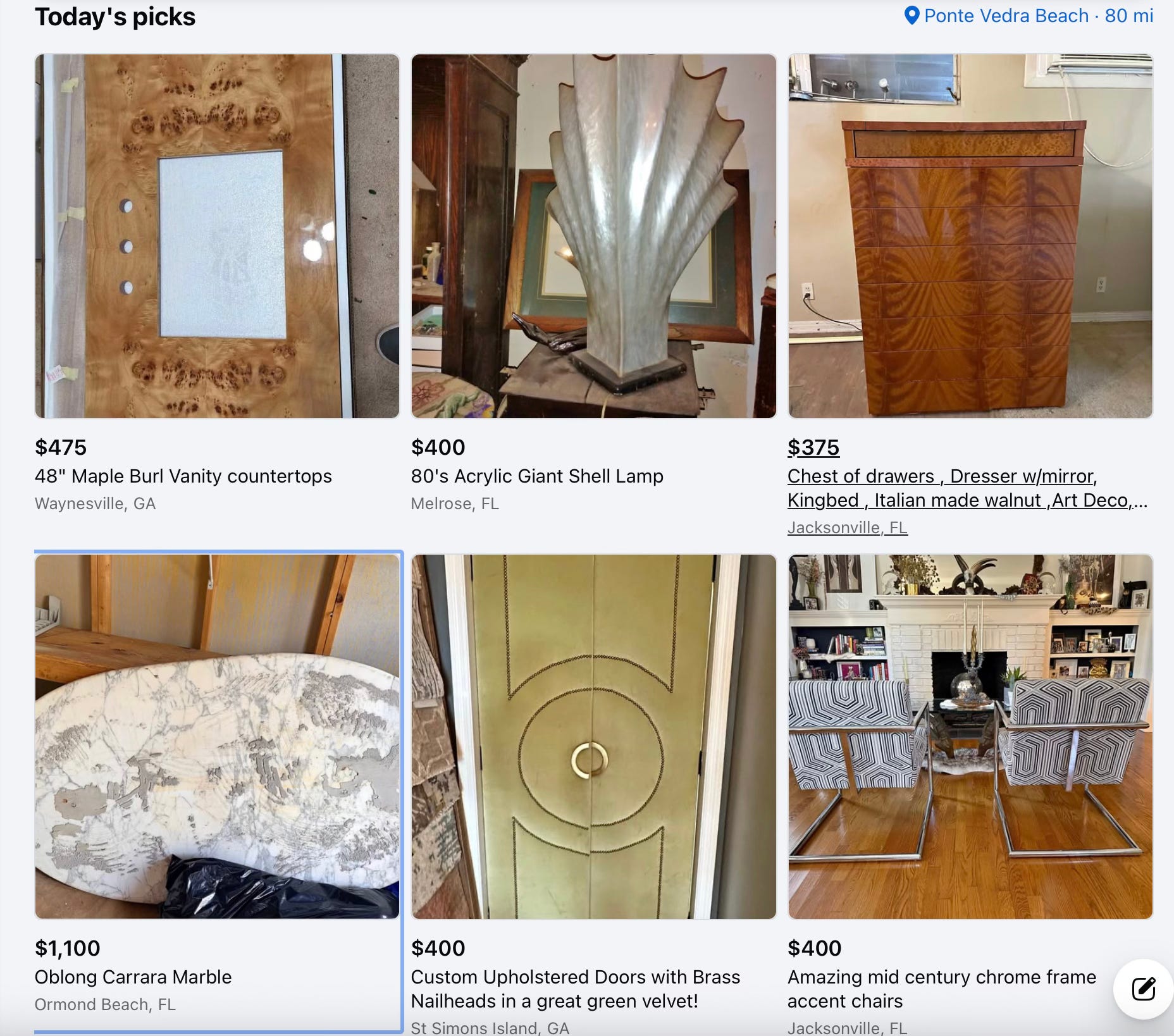
This is why it’s so important to train Marketplace — so it can learn to pull up items it’s learned you like.
The same way I trained my eye in antique malls over the past two decades, I trained the Facebook Marketplace algorithm. That is why my Marketplace homepage serves me travertine tables, Italian ceramics, plaster pedestals, and estate-sale European pieces instead of Amazon returns and “new in box” lighting.
Now — here’s how you can train yours, too.

1. I Only Click on What I Actually Want More Of
Marketplace tracks engagement more closely than people realize — it notices when you click a listing; how long you stay on said listing; when you zoom in on photos; when you save or message.
If I click on a weird adult-sized doll that is clearly just clickbait, the Marketplace algorithm does not know that I clicked out of disbelief. It only knows that I engaged.
So I don’t click on things that are misaligned with my taste or my resale strategy. I do not indulge curiosity when it comes to bad design, because curiosity is interpreted by the algorithm as preference.
If you click on stuff you hate, you are signaling that you like it and if you want better results, you have to stop feeding the machine the wrong signals.
