


Today is a one-year anniversary of a moment I never thought I’d experience: the day I saw my father for the first time, as he stood in shackles and I stood before him and a judge, imploring the judge to put him away for life.
He was on trial for attempted murder, after stabbing an ex-girlfriend nearly to death at her workplace. The stabbing came 40 years after he shot my mom in the head with me (then six weeks old) in the car next to her.
Looking back now feels like watching a movie. I remember throwing up, and not being able to eat. I remember trying very hard not to cry, but crying anyway.
And I remember all that came after — how his relatives (mine too, I guess) wrote me hateful messages on Facebook. How he himself continues to write me through a burner account that he has somehow managed to access in prison (proof that men like him are incapable of change, motivated by ego and pride and wholly without any self-awareness or moral compass).
I wrote this essay prior to the hearing and thought it worth sharing now. I’ve included an addendum, so you can read what I told the judge. He referenced my statement in handing down the maximum sentence of 30 years, making it the most important thing I’ve ever written.
Thanks for all your support.
xx,
VC
One night when I was 13 years old, a face appeared at my bathroom window. I was getting ready for bed when I saw it: a round, moon-like thing that popped up from the darkness, illuminated in the glow of the house, features masked by the undulations in the glass block windows.
At first, I thought I was imagining it, until the face moved. I don’t remember ever being so scared as I was in that moment, slowly turning to glide past the face in the window, walking out of the bathroom and into the living room, where my grandmother was watching television.
“There’s someone at the window,” I said, to which she replied, “Of course there’s not, you’re being dramatic,” then made a big production out of dragging her legs over the edge of the couch, standing up, and walking into the bathroom to show me just how dramatic I was.
“See? There’s no one there,” she said gesturing to the now-empty window. She had opened her mouth to tell me I was seeing things when, just like that, the face popped up again.
“Go in your room. And lock the door,” she told me.
The police officer that came over later found nothing other than a footprint outside, though he mentioned a neighborhood boy had been caught doing this kind of thing in the recent past.
Looking back, it probably was just some boy, which doesn’t really make it less creepy but does mean that it wasn’t the one person my grandmother no doubt thought it was: my dad.
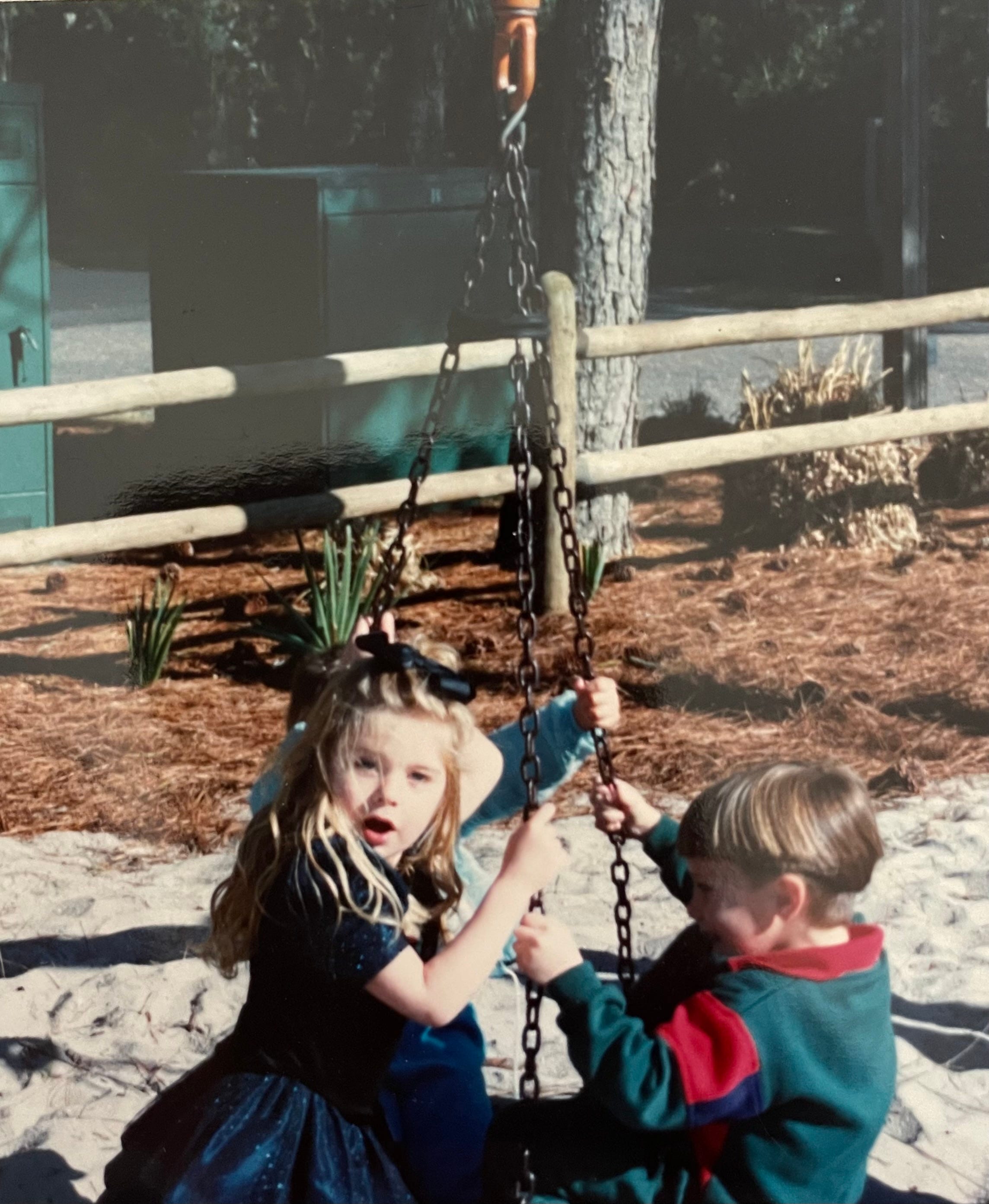
My dad was, for most of my life, merely a concept. He shot my mom when I was two months old, weeks after she left him and obtained a restraining order. He planned it out ahead of time, walking into a gun store with a friend to obtain the weapon, hiding in some brush in a parking lot near my grandmother’s house. He watched us pull out of her driveway, then he shot at the car — at my mom, and me, and my grandmother — twice. He struck my mom in the head on his second try. Following weeks in a coma and intensive care, she survived.
He was charged with aggravated assault which, in Georgia, can sometimes be used in lieu of attempted murder. The legal distinction lies in the intent and the nature of the act — aggravated assault typically involves causing serious bodily harm with a deadly weapon; attempted murder requires a specific intent to kill.
He was sentenced to two counts: aggravated assault, which came with a sentence of 10 years, and aggravated battery, which came with 20 years.
He got out in six.
I imagine my grandmother was notified when he was released in 1991 and, while she never outwardly let on that she was fearful, there were certainly signs.
Following my mom’s rehabilitation in a trauma center, the three of us moved to Florida, where my grandmother bought a piece of land in a gated community and drew up plans for a four-bedroom house. One of the bedrooms was built for me and it had no windows and a row of panic buttons installed in the wall. There was one button to call the paramedics, one to call the fire department, and one to call the police.
I never thought much of the buttons, other than that they must be in every home. And I never thought much of the lack of windows until I had slumber parties and everyone slept til noon (without natural light, you never know what time it is).
It was in the home with my windowless bedroom that the face at my bathroom window appeared. And while there was a brief glimmer of “was it him? did he find us?” it was exceedingly rare for me to ever even think about my father. I was never hamstrung by my fears of him, because he never felt real to me.
My grandmother took precautions, doctoring many of my school records so that I could go by her last name — Hollingsworth — and a shortened version of my first name — Ginny.
I was Ginny Hollingsworth until I was 18 years old, when I began going by what was always my real name, Virginia Chamlee, but what many assumed was some new identity I came up with on a whim.
I was Virginia Chamlee when social media and search engines became the de facto research method. That was when I first Googled him, out of boredom on a random Saturday afternoon.
A few clicks of a keyword and there he was — in a mugshot, staring blankly at the camera beneath fluorescent lights.
There was no pang of recognition. No “we share the same eyes,” or, “look — that dimple’s just like mine.” Just a mugshot of a rather unattractive man. The kind who looked like he would leer at me in a gas station.
And there, below the photo, was his incarceration history.
One would think that getting away with attempted murder might make you reformed — or, at least, appreciative enough of your freedom that you don’t take it for granted.
Not so, in the case of my father, whose resume included time served in 1980, 1982, 1985, 1994….
In fact, when I saw his photo for the first time, I noted that he was just about one year in to serving a 30-year sentence for trafficking amphetamine.
I made a mental note and took comfort in knowing that he’d probably never be free.
At that point, my grandmother had sold her house with the windowless room. No doubt the new owners had already broken through the plaster to let the light in.
I lived the first part of my adult life not thinking about my dad at all, really. I worked, I launched a successful vintage business, I traveled. Then my grandmother died in a car accident and I became the primary caretaker for my mom.
I started thinking about him a little more then, in the kind of way you might think of someone who threw a grenade into a room and left you to pick up the shrapnel.
Of course as I grew older, so did he, and so did technology, evolving to the point that it’s now much easier to find people — even to message them. Even if they don’t want you to.
Before my grandmother’s death, she had me set up a Facebook page for her furniture store — one that I rarely looked at, but still got notifications for, even five years after her death.
The first time I saw my dad had left a comment on the store’s page was in September 2024. “Beautiful furniture,” he wrote. “Reminds me of a girl I once knew.”
To a stranger on the internet, it would be innocuous but to me, it was a punch in the gut. It meant he was out.
The comments on the store’s page continued for a couple of weeks before I had the thought to check my mom’s personal Facebook page. Due to her injuries, she doesn’t often share photos of herself online. Her profile photo was, instead, the logo for my grandmother’s store, which meant he must have thought the store was hers. I deduced that the comments on the store’s Facebook page were a way to get my mom’s attention. My fears were confirmed when I checked her personal “message requests” — this purgatory-like folder that keeps notes sent by strangers in limbo, so you never actually see them unless you go looking.
He had written her dozens, spanning weeks.
“Are you secretly happy and excited to hear from me?”
“I really believe you have loved me since 1983.”
“Send me pictures.”
“Where does our beautiful child get her writing from? Or that high powered drive inside?”
“I love you. Hope you both are perfect. Give her an extra hug but don’t tell her it’s from me.”
“You moved on … I can’t and honestly I have no desire or intent to.”
So consumed was I by the thought that I somehow lucked out and escaped my father that I was shocked when I didn’t. There were no windows, but he still got in.
Some of his messages were crude, sexual, disgusting. In others, he detailed the shooting, moment by moment. In one, he said he was urging his friends to buy my book. In many, he swore he was sorry, swore he was changed.
Weeks later, he would try to kill another woman.
This is the part of the story that becomes almost self-referential. It’s an essay about an essay or, at least, what happened after I published one.
We never hit “accept” on the messages, and we certainly never responded, instead taking time to determine what to do next.
But on a Wednesday in October, I hit send on an essay here on Substack. The essay was not so much about him, but about the shooting and how I had worked to rebuild my life into something beautiful in the years that followed.
It was a nice respite from the fear, to bask in the kind messages and emails and comments I received in return. Maybe this is the whole point, I thought. Finding the beauty in something really ugly.
I felt optimistic about the situation even two days later, as I sat in a Vancouver convention center preparing to go onstage to discuss my tips for finding valuable things at thrift stores.
The “ping” on my cell phone alerted me to a message from my cousin. In it were two screenshots of a news article: Calhoun Man Suspected in Dalton Stabbing.
It was about a man who went to the store where his ex-girlfriend worked and stabbed her in full view of the customers. He then fled on foot and stabbed himself while police officers surrounded him.
It was about my father.
The woman he stabbed survived, following intensive surgeries. We’ve even been in brief contact on social media, bound as we are now by the invisible string of victimhood.
He survived, too, and was charged with aggravated assault, possession of a knife during the commission of a felony and, finally, attempted murder. Being that the stabbing occurred in the middle of the day and in a public place, it was caught on tape, and with multiple witnesses.
It’s a strange feeling, to know safety after recent months of being not-quite-sure where he was. Not-quite-sure if he’d reappear. Not-quite-sure what he meant by “I have no desire or intent” to move on.
While he's in custody, he can’t hurt anyone. But, of course, we’re all still hurting.
I’ve long been plagued by the thought that there’s an alternate reality — one in which he didn’t do it at all, or one in which he did it later, when I was old enough to remember. Or one in which he did it to me instead.
There is now a possibility that I may see my father outside a grainy mugshot — this time, in a courtroom, to deliver a statement before the judge who would determine his sentence, should he be found guilty.
I’m at once paralyzed by fear and excited at the possibility of justice, pondering what exactly I could say about the man who took so much from me.
I could explain how I take care of my mom now. How she has a standing doctor’s appointment once a month (plus three or four others, littered throughout the weeks). How I tell time by when she gets her pills: 8 AM, 3 PM, and 9 PM — something for pain, for nerve damage, for seizures, for depression.
Or how, as a little girl, I told my friends my mom could do a great trick — remove her right eye — and then I’d ask her to take out her prosthetic eye from its socket, while the other small children screamed in horror. Some cried.
I could explain how I see her every day but I don’t really know my mom — the person she is without the brain damage and the medications and the memory loss. How I’ve spent a lifetime trying to reconstruct a woman I can’t fully grasp.
And I could explain how I’ve never even spoken to my dad. Never so much as blinked in his direction, or breathed the same air. But I do know him.
I know that he isn’t sorry.
I know that his violence won’t abate.
I know that he’d do it again.
I know that he deserves a room with no windows, and no light at all.
Addendum
Here is what I read to the judge and the courtroom on Sep. 23, 2025:
Honorable Judge,
My name is Virginia Chamlee and I am Monica’s daughter. In many ways, I am also her mother.
I was born on January 29, 1985. Six weeks later, the defendant shot my mother in the head.
The defendant did not kill my mother, but he still took her from me. The traumatic brain injury she endured made her a different person — one who could not take care of me. Instead, I now take care of her. My life revolves around being her caretaker.
Growing up, my mom was more like my sister — because of the shooting, my grandmother had to raise me and also raise my mom, for a second time.
I was very lucky. My grandmother was my hero. She did the work of a father and a mother and so much more — she pushed me to follow my dreams, to pursue an education, and she quietly ensured I was as safe as possible, even building a room in our home that had no windows and a row of panic buttons on the wall, just in case the defendant ever tried to find us.
When my grandmother died in a car accident five years ago, my world turned upside down in many ways, as I became my mother’s caretaker.
Taking care of someone with a traumatic brain injury is incredibly challenging. Every decision I make now revolves around her doctor appointments, her surgeries, how she’s feeling on any given day. She cannot drive, so I take her to every doctor’s appointment. I administer all of her medications.
And despite the significant impact he had on my life, I did not think of the defendant much at all throughout my life. Until last year, that is, when he began sending my mom messages on Facebook.
In dozens of messages, the man who shot my mother in the head 40 years prior wrote things like:
“Are you secretly happy and excited to hear from me?”
and
“I really believe you have loved me since 1983.”
In one, he wrote, “You moved on … I can’t and honestly I have no desire or intent to.”
My mom never responded to a single message. In fact, she never read any of them. I read them all.
Reading those messages allowed me to understand the fear that gripped my grandmother when she built the windowless room in our house all those years ago. Reading them offered a glimpse of a man who had not changed. A glimpse of a man who could not and can not control his worst impulses. A man who tries to punish women who reject him.
My mom rejected him and he shot her. [Victim #2] rejected him and he stabbed her.
I was not shot nor stabbed by the defendant, but I did not get out unscathed. What he took from me — my childhood, my mom, the recent years I have spent as a caregiver — cannot ever be replaced.
While my friends change their children’s diapers, I help change the batteries in my mom’s neurostimulator device. While they feed their babies, I navigate the minefield of my mother’s crippling pain and the myriad health issues that have come as a result of her injuries. She has one eye and no teeth. She no longer has full use of her bladder. She suffers from seizures — one that was so bad she fell and broke her wrist in two places. It was me who took her to the hospital. Me who took her to the twice-weekly physical therapy appointments, which came on top of all the other myriad appointments.
My mother and I are both stuck in a holding pattern — she, by her physical disabilities, and me, by the knowledge that I can never fix her, no matter how hard I try.
What the defendant did when he shot my mom did not end in March 1985 and it will not end today. The surgeries, the medications, the side effects … This will be how my mother spends the rest of her entire life. It has also cast a shadow over mine.
My mother has now lived 40 years as this version of herself. She only got 20 as the woman she was before and it is a tragedy that I will never know that person.
There are multiple victims in the courtroom today and most of them have two lives: their lives before the defendant, and their lives after. Unfortunately, all I have ever known is the after. The defendant robbed me of my mother, my trust in others, and my ability to live a normal life.
For more of the personal stuff, head to these two posts from the archives:

Finding Beauty in a Thrift Store

There is a fortune I have gotten no less than six times — one tucked away in fortune cookies that keeps making reappearances in my life again and again. “You find beauty where others see nothing unu…
I’ll leave you with this…
This may not mean much coming from a stranger on the Internet, but I am so incredibly proud of you. Your story is both traumatic and uplifting, your writing is incredibly moving and all you have accomplished and will continue to accomplish should be revered.
I’m so sorry he was given the chance to hurt more women after all he took from you and your mother. Your letter is a portrait of courage and bravery. Thank you for sharing it. To me, your creativity and love of adventure shine with fearlessness, whether you feel that way or not. Those qualities imbue every post, and it’s one of the things I like most about your account.